
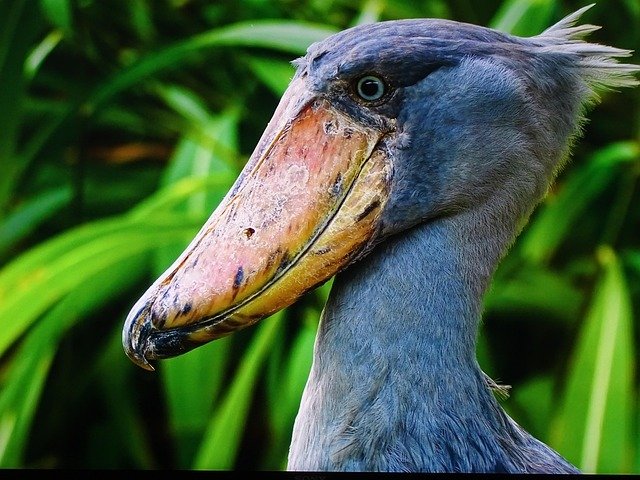
Shoebill Stork
The Uganda Sighting Shoebills-in-the-wild It is common to see the shoebill Storks in areas that are not widely populated, and have plenty of swamps or marshes.
The Shoebill Stork (Balaeniceps rex) The Shoebill stork is one of the uncanniest and prehistoric looking birds you will find on earth. With its intense,
unblinking stare and a bill that could pass for a shoe it seems to have entered the modern world straight from the Cretaceous epoch. This silent, statue-like colossus rules its swampy empire, and is one of the apex predators in its environment.
Where is it Found?
(Habitat and Range)
The Shoebill is an insular species which inhabits freshwater swamps and dense wetlands in the centre of tropical Africa. Fragmented and very specific is its range:
Countries: Mainly in Uganda (around Lake Victoria and Mabamba Bay Swamp), South Sudan (the extensive Sudd wetlands), Zambia (Bangweulu Swamps) Rwanda, eastern Democratic Republic of Congo, Tanzania.
Habitat Requirement: It needs large, fairly preserved papyrus/reed/lungfish-rich swamps. The wetlands must include a combination of deep water and shallow water, floating vegetation, and open water for feeding. It is very sensitive to human disturbance and habitat destruction.
What is its Colour? (Appearance)
The Shoebill is both unmistakable in shape, and colour, which has something to do with Its ancient persona:
General plumage: Its body is mostly blue grey or slate grey allowing for very effective concealment among the shadowy reedy waters.
Back and WingsThe back feathers are gently laced with a slightly darker grey tip, giving the impression of fine scales.
Underparts: The breast and abdomen are a light-gray.
Eyes: Intense pale yellow to whitish grey that so much as gives them a ghostly look.
The Goliath of Bills: The most outstanding characteristic is its massive bill which is yellowish-brown or horn-coloured with dark grey markings.
It is designed like a giant wooden Dutch clog, but with a pointed, hooked beak at one end for striking at and killing its prey. This bill gets 24 cm (9.4 in) long, and the width measures 12 cm (4.7 in).
What Does it Like to Eat? (Diet)
The Shoebill is a sit‐and‐wait apex predator with patience and aggression waiting for the prey to come close by. Diet: The diet of this specie is very specialized and their main meal are aquatic animals such as,
Preferred prey: Its preferred meal is the lungfish, which it deftly removes from mud. It also has a strong diet of bichirs, another fish that looks sort of prehistoric.
Other Food: It feeds on catfish, tilapia, water snakes, monitor lizards, young crocodiles and frogs.
Method of hunting : A “sitting and waiting” hunter, it stands motionless before making a sudden lightning-fast and savage attack. It slash off with its billing cutting edges, and uses as a pair of scissors or machete to decapitate or perforate large prey. It often shakes its prey to dislodge plants before swallowing it.
How Rare is it? (Conservation Status)
The Shoebill is listed as “Vulnerable” on the IUCN Red List and has an estimated global population of 5,000 – 8,000. Its numbers are declining.
Causes of Rarity:
Habitat Destruction & Degradation: The biggest threat. Drainage of swamps for agricultural production, oil and gas exploration and human habitation destroys its home.
Distraction: Nesting birds are hyper-alert to human presence; they may abandon eggs or nestlings if disturbed.
BLACKMARKET TRAFFIC: Chicks and eggs are occasionally taken for the illegal trade in wildlife.
Hunting: They are sometimes hunted for meat or as souvenirs.
Slow Breeding Rate: Shoebills breed slowly. They have only one or two chicks per nesting season, and the chicks are slow to come of age, so recovery in a population is also slow.
The Shoebill Stork is a bona fide throwback to another age, a regal and imposing bird that dominates the still, wet mazes of Africa. Its dinosaur appearance is as fierce as the manner in which it hunts.
Its scarcity is a direct result of the reduction and destruction of the continent’s essential wetlands. Protecting the Shoebill also means safeguarding these large, wild swamps
a daunting task not only for this living relic, but for the health of its entire ecosystem. Observing a Shoebill in the wild, poised like a stone image before unleashing prehistoric force, is an encounter with the ancient spirit of Africa that one never forgets.